Some members of the Obama administration have worried that Pakistan's heightened anxieties about India might lead Islamabad to take reckless measures, so they have wanted New Delhi to pursue more diplomatic engagement with Islamabad.
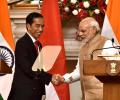
The two countries, among the very few fast growing large economies globally, also decided to boost bilateral trade and investment in areas of oil and gas, renewable energy, IT and pharmaceuticals, during talks between Prime Minister Narendra Modi and Indonesian President Joko Widodo.
India is currently a relatively small market for the US, in terms of total US exports.

He also asserted that India has not given up on SAARC, but it will keep looking for other opportunities for regional integration "since SAARC is stuck".

'The Senators were playing safe, not angering either the pro-India lobby or the pro-Pakistan lobby, but perhaps more importantly, the military-industrial complex -- the most powerful lobby of all -- which the majority of Senators are beholden to in terms of largesse to their campaign coffers.'

The outcome of the Bangkok NSA-level talks underscores that Pakistan has got exactly what it wanted -- talks at different levels, talks on Kashmir, talks on mutual concerns regarding terrorism, talks on ceasefire on the border. What if any has been India's gains remains unexplained, says Ambassador M K Bhadrakumar.

Excerpts from Prime Minister Narendra Modi's speech at the Combined Commanders Conference on board the INS Vikramaditya at sea, off the coast of Kochi.

'In Chinese perception, India is strategically getting closer to United States and some Chinese analysts fear perhaps one day it may become a part of American arrangements against China.'
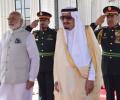
India's ties with Saudi Arabia have been on an upswing over the last two decades based on burgeoning energy ties. Both sides are keen on expanding the economic ties in a range of areas besides the oil sector.

The Saudi-Pakistan nuclear weapons cooperation is meant to sound alarm bells in Washington, reminding the Obama administration that its overtures to Iran would have serious negative consequences in terms of its ties with its closest allies in the region, says Ambassador Talmiz Ahmad. Exclusive to Rediff.com
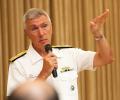
Admiral Samuel J Locklear III, Commander of the US Pacific Command, has not ruled out militants fighting in Afghanistan today switching their attention back to Kashmir post-US and NATO withdrawal of its troops from Afghanistan, and expressed concern over the recent terrorist attacks across the Line of Control that has exacerbated tensions between India and Pakistan.

President Xi said that the Chinese side is ready to work with the Indian side to carry forward the fresh impetus of bilateral relations.

Japan could soon be the second country after the US with which India has a logistics support agreement. Besides the LSA, India and Japan may also sign a maritime domain awareness agreement which would enable the two navies to share information. For example, if a Japanese P-1 maritime patrol aircraft detects a Chinese submarine in the Indian Ocean, it would pass on the information to the Indian Navy, reveals Ajai Shukla.

The prime minister, accompanied by senior officials including National Security Advisor Ajit Doval and Foreign Secretary S Jaishankar, met the Chinese leader just before his travel to Myanmar from this port city.

'We should expect a cold-blooded, transactional relation that requires a lot of engagement and mutual trust to sustain,' says Constantino Xavier, Fellow, foreign policy, Brookings India.

Under the deal, Lockheed will shift its Fort Worth, Texas plant to India without directly affecting American jobs.
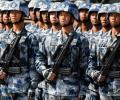
While China's nationalistic tabloid Global Times said India should be taught a 'bitter lesson', another official newspaper, China Daily, said India should look in the mirror.

Terrorism and Afghanistan were the focus points of Prime Minister Narendra Modi's talks with Uzbek President Islam Karimov on his first visit to Central Asia.

The two countries also asked all nations to stop cross-border movement of terrorists and asserted that a decisive collective response from the international community without 'double standards and selectivity' was required to combat the threat of terrorism.

Text of PM Narendra Modi's press statement after delegation level talks with US President Obama at the Hyderabad House in Delhi.
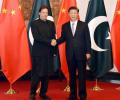
'The scheduling of Imran Khan's visit to Beijing and its focus on the J&K situation underscores that Beijing shares the Pakistani concern that tensions with India are only going to escalate further in the period ahead,' says Ambassador M K Bhadrakumar.

"It is a reflection of the bipartisan support in the US to the relationship with India. It is also a reflection of the value people attach to this relationship," Singh said.

'After a strategic pause though, Beijing will revive its policy of slowly creeping towards acquiring sovereignty over the South China Sea.'

The clichd path of conducting 'uninterrupted and uninterruptable' bilateral dialogue with Pakistan to improve ties remains unimplemented and un-implementable under prevailing circumstances that are unlikely to alter in the near future, says Rahul Bedi.

'Washington is telegraphing here is its willingness to support a low-grade, limited use of force meant to send a strong message to Pakistan.' 'Perhaps something along the lines of the surgical strikes in 2016, or perhaps something a bit more -- but not much more.'
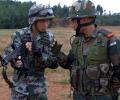
Hua also said China is ready to hold talks with India to resolve differences on CPEC.

'Xi Jinping got a dose of Modi's medicine inside the tent where he was being hosted on the banks of the Sabarmati river.' 'Modi reportedly told him, looking deep into his eyes: "This was not expected of your country. Can you tell me when the troops are withdrawing?".'
'It seems likely that the February 2019 crisis is over.'
India is likely to announce its targets for the Paris deal by September-end.

Prime Minister Narendra Modi enjoys a close relationship with Shinzo Abe. For Abe, "a strong India is in the best interest of Japan, and a strong Japan is in the best interest of India."

'The Chinese forces in the narrow Chumbi Valley are currently in the line of sight and fire of Indian forces poised on the ridges along the Sikkim-Tibet border.' 'Aware of this vulnerability, the Chinese have been eyeing the Doklam plateau,' explains national security expert Nitin A Gokhale.

'The danger today is that out of sheer fatigue and exasperation, the US might cut loose and exit from Afghanistan leaving it to the region to cope with the debris, which it is ill-equipped to handle,' says Ambassador M K Bhadrakumar.
The meeting, which comes after the Doklam standoff, is aimed at a working a new paradigm for the bilateral relations for the next 15 years.

'The world may be desirous of peace, but not Kim Jong-un.' 'Should we then accept the old adage that to maintain peace, we should be prepared for war?' asks Rajaram Panda.

In bilateral interfaces relations with China have also to be given due weight, opines Premvir Das

Chinese mobile brands are deeply entrenched in the Indian market. A move to bar them may send a bold diplomatic message. But its cost for the local industry is anybody's guess. In the event that Chinese brands face curbs, two handset makers - Samsung and Apple - squarely stand to gain.

'China refuses to talk to India on nuclear or ballistic missile issues and conclude any de-targeting agreement as Beijing did with Russia or a non-targeting agreement with the US.'
'The focus on countering terrorism brings to the issue Beijing's non-serious approach in this regard. India's permanent representative at the UN has raised in vain the issue of funding and the release of 26/11 suspect Zaki-ur Rehman Lakhvi. But China has blocked these objections since December 2014 at the UN even after 'highest levels' in India intervened,' notes Srikanth Kondapalli, reviewing the India-China military exercises in Kunming.

'It was China's rise that caused the New Cold War in Asia as it prompted the United States to rebalance its forces in Asia to experiment with engagement and containment at the same time,' says T P Sreenivasan.
'Terrorism is merely a symptom of a deeper disease in Pakistan's body politic,' says Colonel Anil A Athale (retd).
